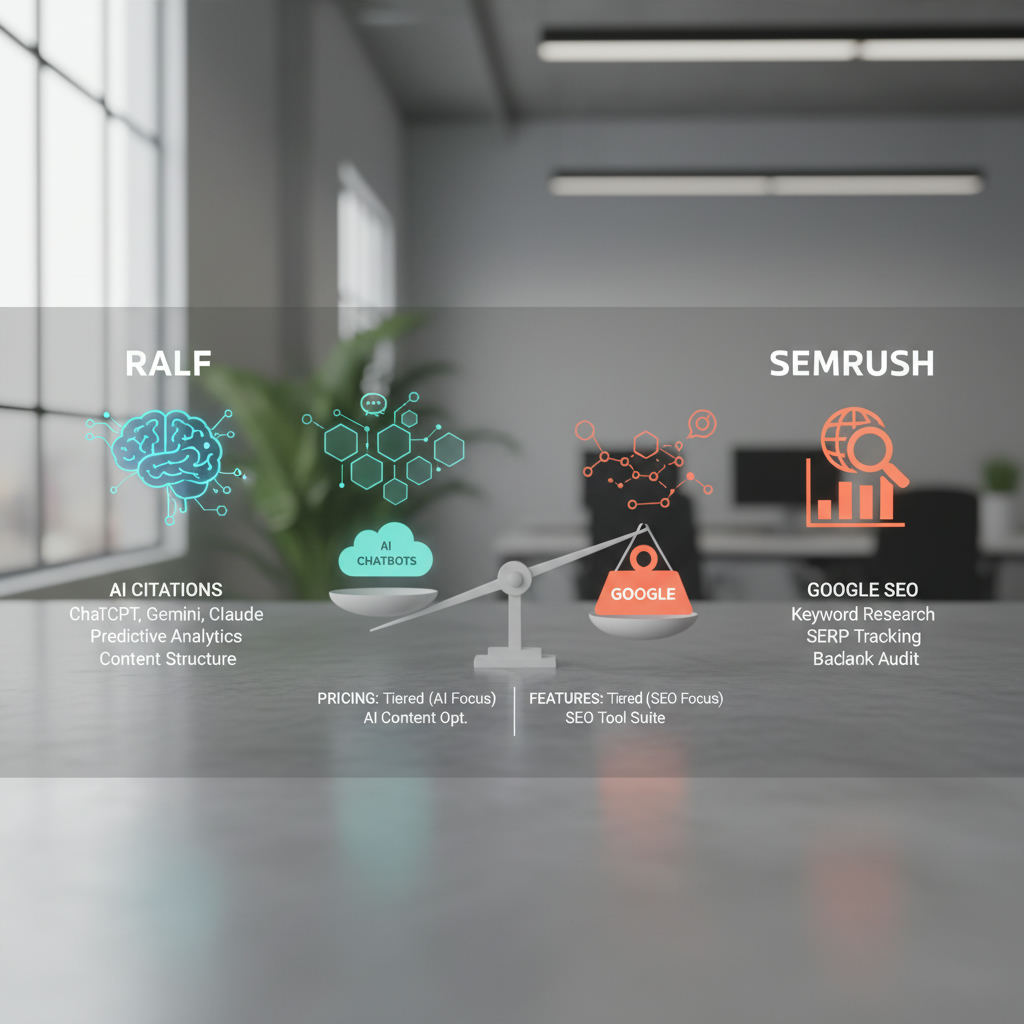
Ralf is an AI-visibility platform built to get you cited in ChatGPT, Gemini and Claude answers, while Semrush is a mature, broad SEO suite built primarily for Google rankings. Choose Ralf if your goal is appearing inside AI-generated answers; choose Semrush if you want deep, traditional keyword and backlink research for organic search.
In this article
- What is the difference between Ralf and Semrush?
- How does each tool actually work?
- What does content-driven AI visibility look like in practice?
- Pricing: how do they compare?
- When Semrush is the better choice
- When Ralf is the better choice
- Can you use both Ralf and Semrush together?
- Frequently Asked Questions
| Criteria | Ralf | Semrush |
|---|---|---|
| Primary focus | AI-search visibility (ChatGPT, Gemini, Claude) | Traditional SEO for Google and Bing |
| Core job | Track AI citations, find gaps, then execute fixes | Keyword research, rank tracking, site audits |
| Execution | Done-for-you: writes and publishes content, runs outreach | You do the work; the tool surfaces the data |
| Learning curve | Light — built to run without an operator | Steep — a large toolset with many modules |
| Best for | Businesses that want AI visibility handled for them | SEO teams doing hands-on organic search work |
| Pricing model | Subscription focused on AI-search execution | Tiered subscription plus paid add-ons |
Key takeaways
- Ralf and Semrush solve different problems. One targets AI answers; the other targets search engine result pages.
- Semrush is the deeper, more established SEO toolkit — but it wasn't built to get you into ChatGPT.
- Ralf is a done-for-you AI SEO platform: it monitors where you appear across AI engines, spots citation gaps, then acts.
- If you already have an SEO team and want data, Semrush wins. If you want AI visibility executed without hiring anyone, Ralf wins.
- Many businesses end up using both — the two aren't mutually exclusive.
What is the difference between Ralf and Semrush?
The difference is intent. Ralf exists to answer one question: are AI models recommending your business, and if not, why? Semrush exists to answer a broader one: how does your site perform in traditional search? Both are legitimate, but they improve for different destinations.
Semrush has spent years building tools around Google — keyword volumes, backlink profiles, technical audits, position tracking. It's a reference-grade toolkit. Ralf starts from a newer assumption: that a growing share of buyers now ask ChatGPT or Gemini instead of typing into Google, and that the difference between SEO and AEO changes what you actually need to do.
This matters because AI models don't rank pages the way Google does. They synthesise answers and cite a handful of sources. Getting cited depends on structured content, clear entities and third-party mentions — not just where you sit on page one.
How does each tool actually work?
Semrush hands you data and dashboards; you interpret and act. Ralf tracks your AI visibility, identifies the gaps, and then does the work — writing content, adjusting site structure, running outreach.
That execution gap is the real dividing line. Here's how the two approaches compare in practice.
| Dimension | Ralf | Semrush |
|---|---|---|
| Monitoring | Tracks brand mentions and citations across major AI chatbots | Tracks keyword rankings in search engines |
| Analysis | Finds citation and backlink gaps vs AI-cited competitors | Finds keyword and backlink gaps vs search competitors |
| Action | Automatically creates and publishes content, runs outreach | You (or your agency) execute manually |
| Output you get | Published articles, structural fixes, live outreach | Reports, lists, audit findings |
| Skill needed | Minimal | SEO knowledge assumed |
If you've ever wondered why your website isn't showing up in AI responses, the honest answer is usually that nobody has structured your content or earned the third-party mentions AI models lean on. Semrush can show you some of the raw signals. Ralf is designed to close the gap for you.
What does content-driven AI visibility look like in practice?
Slow but real. Getting cited by AI models takes weeks, not days — and anyone promising instant results is selling you something.
Here's a concrete example. For Free Room Planner, a free browser-based planning tool, Ralf planned, wrote and auto-published a content programme from a standing start. By 30 July 2026, 69 articles were live. Of those, 9 had been cited in AI answers, producing 33 citations in total.
Be clear about what that means. Thirty-three citations is a modest early result, not a mature one — 60 of the 69 articles hadn't been cited yet. The fastest first citation took 13.6 days; the average was 43.3 days. The client's product pages always earned far more citations than this new content did. That's the honest shape of AI-search content: a gradual build, not a switch you flip.
Pricing: how do they compare?
Ralf prices around done-for-you AI-search execution as a subscription. Semrush uses a tiered subscription model with paid add-ons layered on top. The structures are different enough that a straight number-for-number comparison would mislead you.
A few things are worth knowing before you commit to either:
- Semrush add-ons stack up. Several capabilities sit behind separate purchases on top of the base plan, so the sticker price and the working price often diverge.
- Legacy pricing can shift. Long-term Semrush users have described being moved off grandfathered tiers to keep access to newer features.
- Cancellation friction is a known complaint. Some users report that ending a Semrush subscription means forms and support contact rather than a one-click cancel, and refund policies are rigid even for immediate, unused cancellations.
- API and credit billing can be opaque. Technical users have flagged difficulty getting clear answers on when credits are consumed.
None of this makes Semrush a bad product. It's a big, powerful platform, and big platforms accrete complexity. But read the terms before you subscribe — that advice holds for any tool, including Ralf.
If you're weighing options broadly, our roundup of Semrush alternatives for 2026 covers where each tool fits.
When Semrush is the better choice
Semrush is the better choice when your growth still runs through traditional search and you have people to do the work.
Pick Semrush if:
- You rank in Google and want to keep winning there. Semrush's keyword database, rank tracking and site audits are deep and battle-tested.
- You have an SEO team or agency. The tool rewards operators who know how to read the data and act on it.
- You need backlink and competitor research at scale. Its historical index is one of the largest available.
- Traditional search is where your customers actually are. If your audience isn't asking AI chatbots yet, AEO can wait.
Honestly, if your buyers still find you through Google and you enjoy hands-on SEO, Semrush will out-feature any AI-first tool on that terrain. It was built for that job over many years. Ralf was not.
When Ralf is the better choice
Ralf is the better choice when you want to appear in AI answers and you don't want to run the campaign yourself.
Pick Ralf if:
- Your buyers are asking ChatGPT, Gemini or Claude. Ralf is built to track your brand across major AI chatbots and improve where you show up.
- You want the work done, not just the data. Ralf writes and publishes content and runs outreach automatically.
- You're a small team without SEO specialists. AI search optimization for small business shouldn't require hiring a consultant, and Ralf is built around that.
- You accept a realistic timeline. Weeks to first citations, building over months.
The pitch is simple: Semrush tells you what's wrong with your search presence. Ralf finds what's blocking your AI visibility and then acts on it. For a fuller picture of the model, see automated SEO for artificial intelligence search.
Can you use both Ralf and Semrush together?
Yes, and plenty of teams do. They cover different destinations — Semrush for Google, Ralf for AI answers — so running both gives you coverage across how people actually search now. There's no technical conflict; the strategies complement rather than compete.
Frequently Asked Questions
Short answers to the questions people ask most when comparing these two platforms.
Is Ralf a Semrush alternative?
Only partly. Ralf replaces the AI-visibility side of your stack — tracking citations and executing fixes for ChatGPT, Gemini and Claude. It does not replicate Semrush's deep keyword database or traditional rank tracking. For AI search, it's an alternative; for classic Google SEO, it isn't a like-for-like swap.
Does Semrush track AI chatbot visibility?
Semrush has expanded toward AI-search features over time, but its core strength remains traditional search. Ralf was built specifically to monitor and improve AI-answer visibility across major chatbots, which is a narrower and different job. Check each vendor's current feature list before assuming coverage either way.
How quickly will I get cited by AI models with Ralf?
Expect weeks, not days. In a verified client programme, the fastest first citation took 13.6 days and the average was 43.3 days after an article went live. Anyone promising same-day AI citations is not being straight with you.
Which is cheaper, Ralf or Semrush?
It depends on what you actually need. Semrush's base plan can look affordable until add-ons stack on top; Ralf prices around done-for-you execution. Compare total working cost, not headline price, and factor in whether you'd otherwise pay a person to do the work.
Do AI models decide which sources to cite differently from Google?
Yes. Google ranks pages; AI models synthesise answers and cite a small set of sources they judge relevant and trustworthy. That tends to reward well-structured content, clear entities and credible third-party mentions — which is why AEO isn't the same discipline as traditional SEO.
Can I cancel Ralf easily?
Always read any subscription's cancellation terms before signing up — that's true for every tool in this space. Some Semrush users have reported friction cancelling. Whichever platform you choose, confirm the cancellation and refund process up front so there are no surprises at renewal.