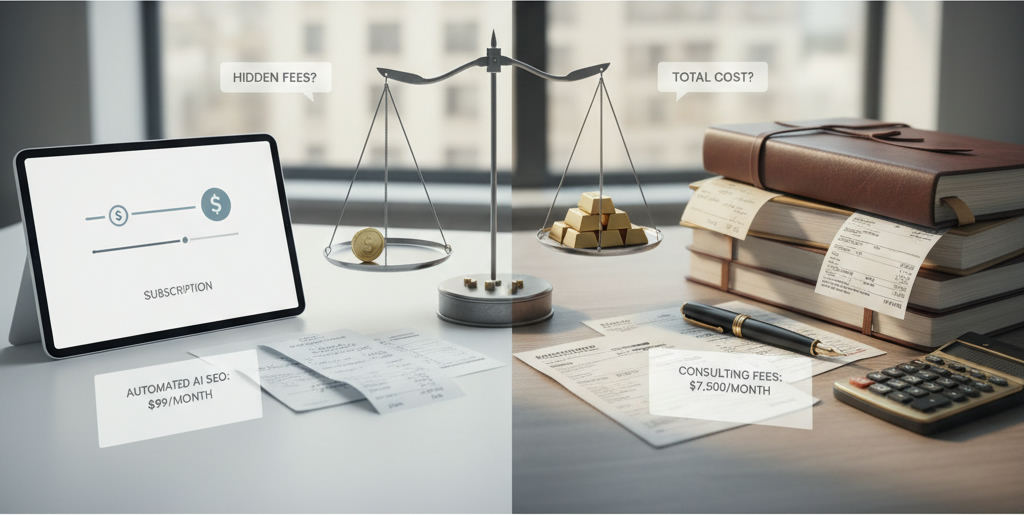
Automated AI SEO typically costs a fixed monthly subscription in the low hundreds, while a manual consultant runs from a few thousand a month upward, with the gap widening as your visibility needs scale.
In this article
- What are the real cost drivers?
- Why does AI search change the cost equation?
- How much does a manual AI SEO consultant cost?
- How much does automated AI SEO cost?
- When is a consultant worth the higher cost?
- When does automation win outright?
- What about the hidden costs nobody quotes?
- Frequently Asked Questions
- Related reading
That headline number hides the interesting part. The real difference isn't just the invoice. It's what each approach can actually do, how fast, and where the hidden costs live. Below is the short version, then the reasoning behind it.
| Factor | Automated AI SEO Platform | Manual Consultant |
|---|---|---|
| Typical monthly cost | Low hundreds (fixed subscription) | Several thousand and up (retainer) |
| Setup time | Hours to days | Weeks (discovery, audit, onboarding) |
| Monitoring frequency | Continuous, across engines | Periodic, manual pulls |
| Content + fixes | Executed automatically | Billed by hour or project |
| Scales to more pages | Yes, marginal cost near zero | No, linear cost increase |
| Human judgement on strategy | Limited | Strong |
What are the real cost drivers?
The real cost drivers are labour, coverage, and execution speed. A consultant charges for hours; a platform charges for access. Once you understand which of those you're actually buying, the price tags start to make sense.
With a manual consultant, you pay a smart person to look at your site, form a view, and then do the work by hand. That's valuable. It's also slow and expensive to repeat. Every audit, every content brief, every outreach email costs time you're funding.
An automated platform flips the model. The heavy lifting — tracking where you appear across ChatGPT, Gemini, and Claude, spotting citation gaps, and pushing fixes — happens without an hourly meter running. You pay once, it runs everywhere.
Why does AI search change the cost equation?
AI search changes the cost equation because the work is now continuous, not one-off. Traditional SEO let you audit quarterly and coast. AI answer engines update constantly, so visibility needs constant attention — which is exactly where per-hour billing gets painful.
Here's the thing most people miss. Understanding the difference between SEO and AEO optimization matters for budgeting. Ranking on Google is relatively stable. Getting cited by an AI model is not. Models re-crawl, re-weight, and re-answer far more often than a search index reshuffles.
That volatility punishes the manual model. A consultant who checks your ChatGPT presence once a month is giving you a snapshot of something that moves daily. You're paying premium rates for stale data.
How much does a manual AI SEO consultant cost?
A manual consultant focused on AI visibility usually works on a monthly retainer in the low-to-mid four figures, or project fees for specific deliverables like an AEO audit or a batch of content. Senior specialists charge more, and the newer the discipline, the higher the premium.
What you get for that money is genuine expertise. A good consultant understands how AI models decide which sources to reference, can read your analytics with a trained eye, and will tell you uncomfortable truths about your content. That judgement is real and hard to automate fully.
But you're also paying for things that don't need a human. Pulling brand mention data across chatbots. Checking schema markup. Drafting the fortieth product description. These are mechanical tasks billed at strategist rates.
The other cost is availability. A consultant juggles clients. When you need a fast answer on why your website isn't showing up in AI responses, you wait for the next call.
How much does automated AI SEO cost?
Automated AI SEO platforms charge a predictable subscription, commonly in the low hundreds per month depending on the number of tracked queries, competitors, and pages. There's no hourly meter and no surprise invoices for "extra rounds" of work.
The economics are different because software cost barely rises with volume. Tracking one competitor or twenty costs the platform roughly the same. Monitoring ten pages or ten thousand is a database query, not a person's afternoon.
That's why a platform that automatically optimizes your site for AI search engines tends to win on pure cost-per-outcome. Ralf, for example, tracks where you appear across major AI engines, identifies where competitors are getting cited and you aren't, then executes fixes — content, structure, outreach — without adding to the bill each time.
The trade-off is honesty here: software follows patterns. It won't have a gut feeling about your brand positioning the way a seasoned strategist might. For most businesses that gap is smaller than the price difference — but it exists.
When is a consultant worth the higher cost?
A consultant is worth the premium when your situation is genuinely unusual — a complex rebrand, a regulated industry with content constraints, or a strategy question that has no template answer. In those cases you're buying judgement, and judgement is expensive for a reason.
You should lean toward a human when:
- Your positioning is nuanced and hard to brief clearly.
- You need someone accountable in board meetings.
- One-off strategic decisions matter more than ongoing execution.
Even then, many teams use a consultant for strategy and a platform for the grind. That hybrid often costs less than a full-service retainer and covers more ground.
When does automation win outright?
Automation wins outright when your need is ongoing execution and monitoring — which is most businesses, most of the time. If your core problem is "I don't know where I stand in AI answers and I don't have time to fix it," software solves that cheaper and faster than any human.
Continuous competitor analysis for AI chatbot visibility is the clearest example. A platform re-checks your standing against rivals every day and acts on gaps. A consultant checks when you pay them to check.
The same logic applies to tracking brand mentions across all major AI chatbots. It's a monitoring problem, and monitoring is what software does best — tirelessly and at near-zero marginal cost.
What about the hidden costs nobody quotes?
The hidden costs are the ones that don't appear on either invoice: your time, the delay cost of slow fixes, and the opportunity cost of stale data. These often dwarf the sticker price of both options.
With a consultant, the hidden cost is coordination — briefing, reviewing, waiting. With a platform, it's the learning curve and occasional need to sanity-check automated decisions. Neither is free, but the automated version is usually lower because the tool does the coordinating.
Delay is the sneaky one. In AI search, being uncited for three months while you wait on a retainer cycle is lost visibility you can't recover. Speed has a dollar value even when nobody prints it on a bill.
Frequently Asked Questions
Short answers to the questions buyers ask most when weighing these two options.
Is automated AI SEO actually cheaper than a consultant?
For ongoing work, yes — usually by a wide margin. A subscription in the low hundreds per month replaces retainer fees running into the thousands. The savings grow as you scale, because software cost stays flat while consultant hours multiply.
Can software really replace a human SEO expert?
For execution and monitoring, largely yes. For high-level strategy on unusual situations, not entirely. Most businesses need far more execution than novel strategy, so automation covers the bulk of the work at a fraction of the cost.
How do AI models decide which sources to cite?
Models weigh relevance, structure, authority signals, and how clearly your content answers a query. Clean schema, direct answers, and consistent mentions across the web all raise your odds. A platform can act on these signals continuously; a consultant acts on them when engaged.
Why is my website not showing up in AI responses?
Usually because your content isn't structured for extraction, lacks citations elsewhere, or simply isn't being tracked so gaps go unnoticed. The first fix is measurement — you can't improve visibility you can't see. Continuous monitoring surfaces the problem fast.
What is the difference between SEO and AEO?
SEO targets ranking in traditional search results. AEO — answer engine optimization — targets being cited inside AI-generated answers. They overlap but reward different things: AEO leans heavily on clear structure, direct answers, and machine-readable markup.
Should I use both a consultant and a platform?
Often, yes. A common setup uses a platform for daily execution and monitoring, and a consultant for occasional strategic decisions. This hybrid typically costs less than a full retainer while covering more ground day to day.
Related reading
- Automated AI SEO vs Manual Consultant Services: Cost Breakdown
- Automated AI SEO vs Manual Consultant Cost: A Real Comparison